Chawan: Mizuno Juzan Kuro Oribe Chawan

- SKU:
- CHW-671
- Minimum Purchase:
- 1 unit
- Maximum Purchase:
- 1 unit
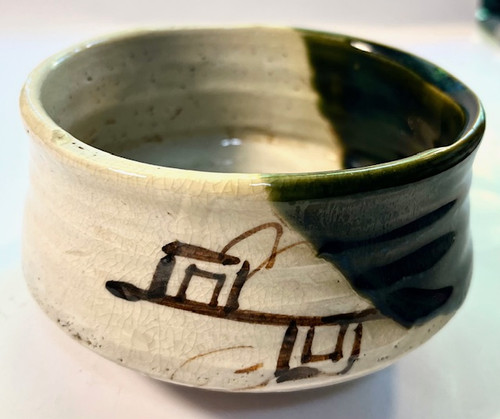
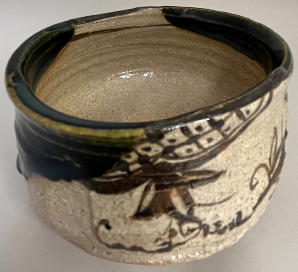
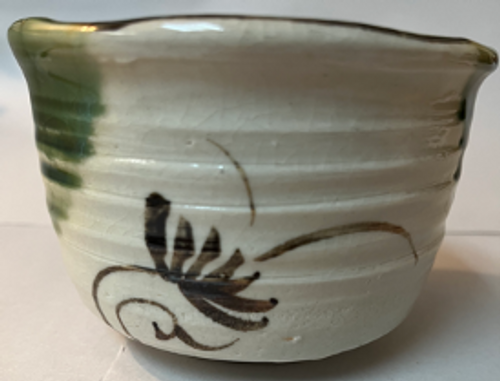
A substantial mid-Shōwa Japanese matcha bowl combining lustrous iron-black glaze with transparent-glazed pale-clay reserves and freely painted lattice-and-dot decoration.
Identification
|
Item number |
CHW-671 |
|
Object type |
Chawan for preparing and drinking matcha |
|
Japanese name |
Kuro-Oribe chawan |
|
Maker |
Attributed to Mizuno Juzan, probably the second generation |
|
Origin |
Seto, Aichi Prefecture, Japan |
|
Period |
Mid-Shōwa period, probably 1950s–1970s |
|
Form |
Low irregular wan-gata bowl with gently distorted rim |
|
Mark |
Circular impressed Juzan seal beside the foot |
Description
CHW-671 is a strongly formed Kuro-Oribe tea bowl with a low, broad profile and an intentionally irregular mouth. A deep iron-black glaze covers most of the vessel, revealing brown, burgundy, and olive undertones where the glaze catches the light. Irregular reserves expose the pale clay beneath a transparent glaze. The principal reserve carries a freely brushed composition of intersecting iron-brown lines and scattered dots, recalling the grids, fences, windows, and textile patterns of Momoyama-period Oribe tea ceramics.
The underside is boldly trimmed around a broad foot. Beside the foot is a circular seal reading Juzan in traditional characters. A documented Japanese auction example attributed to Mizuno Juzan displays an exceptionally close combination of form, glaze division, lattice-and-dot decoration, clay, foot treatment, and the same seal. The attribution is therefore strong, although the shared use of the Juzan art name and seal by two generations prevents an unqualified assignment to the second generation without the original box.
Artist and lineage
Mizuno Juzan II, 1908–1978, was born in Seto as Mizuno Sakae and succeeded to the family art name in 1931. He became known as a tea-ceramics potter and exhibited successfully in the Nitten. His father, Mizuno Juzan I, 1877–1931, was also a respected Seto potter. Published Japanese references caution that both generations used a Juzan seal and can be difficult to distinguish by the mark alone. On stylistic and chronological grounds, CHW-671 is probably the work of Juzan II.